Karenne Wood Native Writer/Artist Residency Program
In November of 2021, The Humanities Research Center launched the Karenne Wood Native Writer/Artist Residency program, providing an opportunity for Indigenous writers and artists to spend time at VCU, connect with local tribes, give public talks and readings, and enrich VCU students’ learning experience.
The program honors the legacy of Karenne Wood, Ph.D., who was a member of the Monacan Indian tribe and a poet, activist, tribal historian and educator who lectured at VCU on many occasions. Wood, who died in 2019, was director of the Virginia Indian Heritage Program at Virginia Humanities, led a tribal history project for the Monacan Nation, conducted research at the National Museum of the American Indian, and served on the National Congress of American Indians’ Repatriation Commission. Her two books of poetry, “Markings on Earth” (2001) and “Weaving the Boundary” (2016) are taught widely throughout North America. In 2015, she was named one of the Library of Virginia’s Virginia Women in History.
This residency is made possible in part thanks to Virginia Humanities and VCU Foundation. We'd also like to thank the School of the Arts for providing studio space for our Karenne Wood Native Artists-in-Residence.

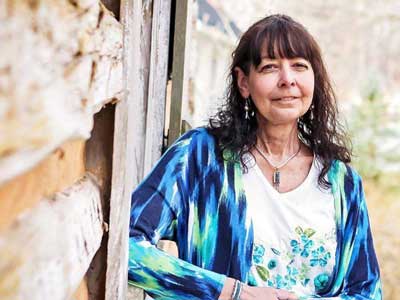
Artist in Residence 2026-27: Denise Walters
Denise Lowe Walters, Ph.D., is a storydriven art quilter, poet, and scientist who weaves together Indigenous knowledge, culture, and history into illustrations and abstract art. She utilizes natural and synthetic materials along with her research scientist’s attention to detail to create story. A citizen of the Nottoway Indian Tribe of Virginia, Walters currently serves as the Tribe’s Council Chair and has previously directed cultural arts programming for the Nottoway Community House and Interpretive Center in Capron, Virginia. Her dual training in chemistry (B.S.) and pharmacy (Ph.D.), both earned at Virginia Commonwealth University, informs her distinctive approach to narrative textile work.
Walters began quilting by creating baby quilts for ABC Quilts, a national initiative supporting at-risk infants. From those early acts of care, she discovered a deeper calling in story quilts. Her works merge fabric, leather, shells, and beadwork together to honor tribal history, cultural renewal, and the lived experience of scientific inquiry. Her handwork is recognized for its meticulous detail and its ability to carry layered stories across generations.
Through her art, Walters advances public understanding of Nottoway culture while illuminating the ways science shapes everyday life. Her quilts have been exhibited at universities, libraries, cultural centers, and museums throughout Virginia and the Carolinas. Recent works include The Brafferton, a tribute to the students of the Brafferton Indian School, now housed in the Swem Library’s Special Collections at William & Mary; Three Sisters in Virginia, celebrating Indigenous foodways, held in the Albert & Shirley Small Special Collections Library at the University of Virginia; and Trusted Science, honoring the collaborative scientific community at Haleon and displayed at their Richmond Virginia site.
Walters continues to expand her practice through projects that bridge art, cultural education, and storytelling, inviting viewers to experience textile work as both historical witness and contemporary dialogue.
Artist Statement
During her residency, Dr. Denise Walters will continue her focus on illustration of Nottoway history and culture. She will design and complete a story quilt that ties together an old Tuscarora legend entitled “A Tree of Language”* with the language revitalization work within the Nottoway Indian Tribe of Virginia community, lead by the artist’ son Ben Walters. The Tuscarora story was selected as it is a sister tribe the Nottoway, both in historical proximity and linguistically. The quilt will weave together the story of one language transitioning to many (much like the biblical tower of babel story), with the societal destruction of indigenous language and modern resurgence of indigenous language as means to reclaim culture and connection.
*“Tuscarora Legacy, of J.N.B. Hewitt, Materials for the study of the Tuscarora language and
Culture”, Volume 1, Chapter 4 “A Tree if Language”, Blair A. Rudes and Dorothy Crouse,
University of Ottawa Press (1987), pp. 91-99.
Previous Artists
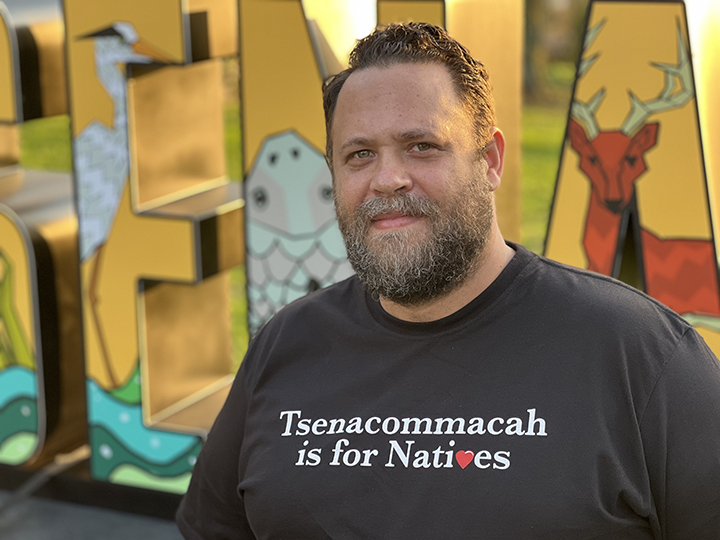
Erick Krigsvold is a Pamunkey citizen, culture bearer and artist living in
Richmond, VA. His work tells visual stories of Native Americans across the
country with a focus on Virginia tribes and culture. Driven by his desire to
explore and celebrate his Indigenous identity, Erick combines digital drawing
with traditional techniques such as screen printing. Erick speaks with students
and schools about Virginia Native history and culture and uses his website and
social media accounts to facilitate tribal education and awareness. He
advocates his mission of Indigenous Education Through Art through his work at
Pow Wows and other Artist markets throughout Virginia. Erick is elevating the
under-represented Native American voice in Virginia and ensuring that the rich
stories of Virginia’s Indigenous people are not forgotten. His work can be found
at thenativestatesproject.com and on Instagram @thenativestatesproject.
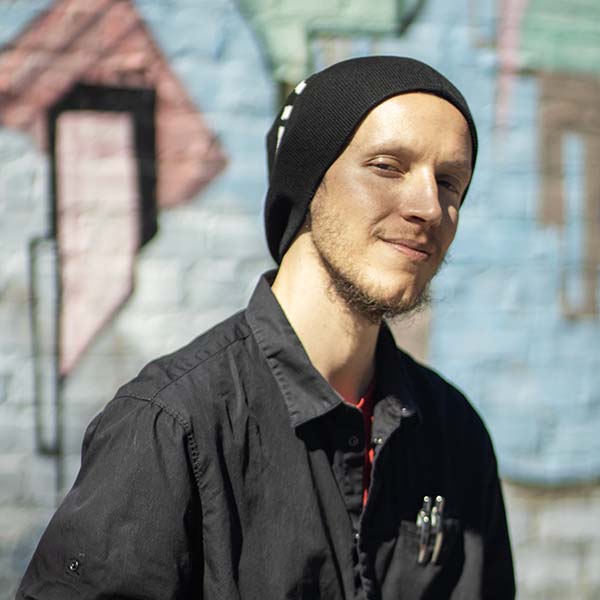
Sequoyah Fortune is a Rappahannock multimedia artist and writer, who seamlessly blends tradition with progressive modernism. Their art mirrors the complexities of multicultural identity, exploring dichotomies such as light and dark, life and death, and what is versus what could be. Inspired by traditional cultural expression, the natural world, and modern artists, Sequoyah has been involved in various artistic and cultural activities from a young age. Pottery lessons from his grandmother, dancing and drumming lessons from uncles and father, sketching lessons from their mother, and beadwork from sister and aunt—all these experiences shaped their artistic journey. As Sequoyah honed his skills across diverse media, he learned from instructors like hyperrealists Norberto Ramirez and Nigel Robertson from Fresno California. Sequoyah’s focus is to demystify art, encouraging everyone to see everyday items and activities as creative expressions. Conversations, community building, and intentional living are also forms of art for them, serving collaborative narratives, preserving history, and helping individuals understand their place in the larger world.
Fortune served as the Karenne Wood Native Artist-in-Residence in the Fall of 2024.

Alicia Aldaz is a textiles and beadwork artist and designer from the Monacan Indian Nation of Virginia. Growing up in Amherst County Virginia, she traveled with her family and tribe dancing and singing at powwows and native performances all over the east coast. At the age of 15, she started exploring her passion in art, and her drive to design, and create dance regalia for herself and her family for powwows. She became eager and enthralled in learning every type of traditional native sewing, beading, and textile techniques she could get her hands on, and never stopped. She has spent decades traveling all over North America learning and researching many different native artists’ divergent forms of craftsmanship and techniques, adapting them into her own contemporary design ideas. While continuously creating and designing dance regalia for her family and her tribe, Alicia’s creative passion has shifted into creating unique native-inspired contemporary wearable art for daily life to allow cultural connectiveness and representation to empower her clients. She debuted her line of Native inspired punk/street wear collection in the 2022 Virginia Tech Indigenous Community Center Fashion Show. She has been asked to return for the 2023 Opening of the Virginia Tech’s fall Community Cultural Centers’ Welcome Back Fashion Event.
Alicia has made it her own personal mission to give back the knowledge she has acquired, and she travels the country teaching classes on beadwork and sewing techniques she has learned to encourage the next generations of artists to carry on. Alicia’s sewing and beading specialties include, but are not limited to: two needle applique, one needle applique, lazy stitch, peyote stitch, bead wrapping, loom beading, rosette work, various edging/finishing techniques, quillwork, parfleche work, machine applique, southern style patchwork, and ribbon work. Alicia’s work can be found at powwows all over the country. She has shown her contemporary designs in multiple fashion shows, craft shows, and design classes.
Aldaz served as the Karenne Wood Native Artist-in-Residence in the Fall of 2023.
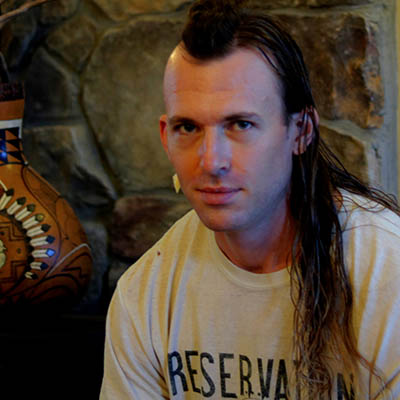
Ethan Brown is a Virginia artist working in multiple mediums including Gourd art, Oil Painting, Sculpture, and Filmmaking. He is a Pamunkey Tribal Citizen and resident of the Pamunkey Indian Reservation in King William, Virginia. A self taught artist— Ethan’s work is inspired by Pamunkey history and culture, Virginia’s flora and fauna, dreams, intuition, and spirituality. He has completed visual art commissions for the Big Ideas Company in London, England; the King William Historical Museum; Chesapeake Bay National Parks; and Reclaiming the Monument, among others. Ethan has had multiple pieces purchased by the Virginia Museum of Fine Arts for their permanent collection. As a filmmaker, Ethan has co-directed and edited the experimental short film Tsenacommacah (2020), as well as contributing additional photography to the EMMY Nominated documentary Connecting Currents- Pamunkey River: Lifeblood of our People (2020). Ethan’s newest film, First Landings (2022) is currently being submitted to National and International film festivals.
Brown served as the inaugural Karenne Wood Artist-in-Residence in the Fall of 2022, hosting a public film screening at the HRC about Indigenous Futurisms and Experiential Symbolism with fellow artist and collaborator Federico Cuatlacuatl.